Posts tagged ‘fcetier’

The Usual Suspects

Usual Suspects article

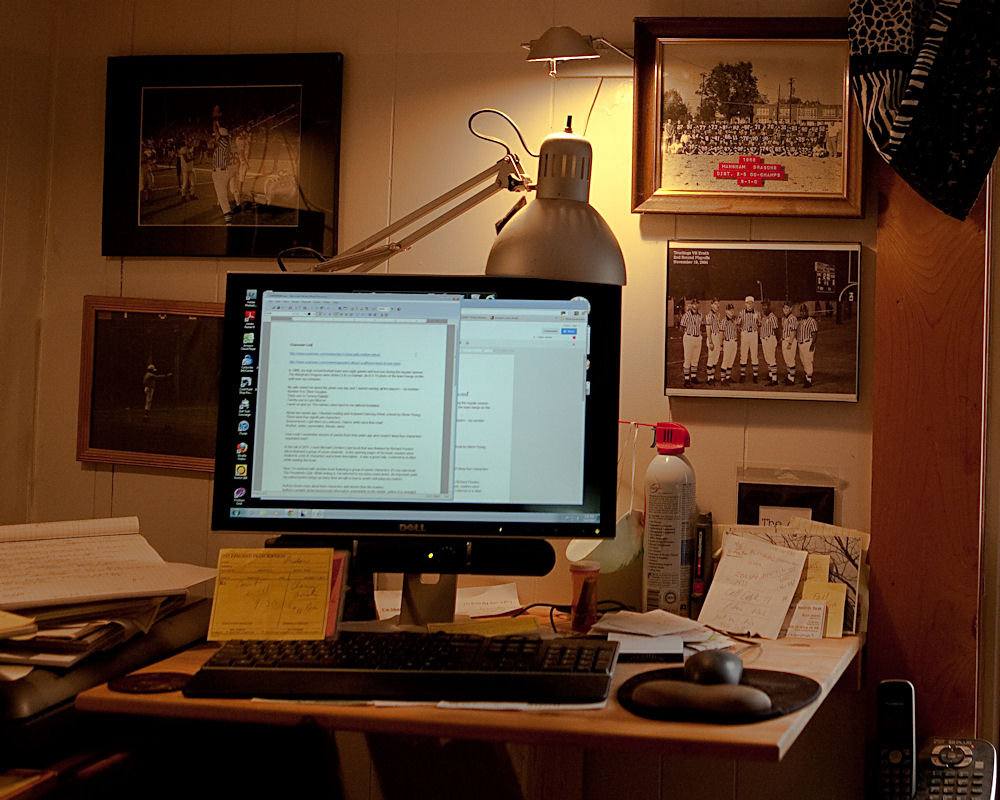
In 1968, my high school football team won eight games and lost one during the regular season. The Mangham Dragons were district 2-B co-champs. An 8 X 10 photo of the team hangs on the wall near my computer. (See top right, notice red label.)

My wife asked me about the photo one day and I started naming all the players — by number.
Number 8 is Oliver Douglas.
Thirty-one is Tommy Pailette.
Twenty-one is Lynn Mercer.
I went on and on. The names came back to me without hesitation.

About two weeks ago, I finished reading and reviewed Dancing Priest, a book by Glenn Young. There were four significant characters.
Several times, I got them so confused, I had to write out a flow chart.
Brother, sister, roommates, friends, twins.

How could I remember dozens of names from forty years ago and couldn’t keep four characters separated now?

In the fall of 2011, I read Michael Crichton’s last book that was finished by Richard Preston. Micro featured a group of seven students. In the opening pages of the book, readers were treated to a list of characters and a brief description. It was a great help. I referred to it often while reading the book.

Now, I’m involved with another book featuring a group of seven characters. It’s my own book, The Presidents Club. While writing it, I’ve referred to my notes many times. An important point my editor/mentor brings up every time we talk is how to avoid confusing my readers.

Authors know more about their characters and stories than the readers.
Authors certainly know background information unavailable to the reader, unless it is revealed in the written word.

If I cannot remember four characters and their relationships, why should my readers be expected to sort out and remember almost a dozen characters? An added complication is that my book is serialized, one chapter each week.

One step we will take soon is to begin presenting two chapters a week rather than one.

Another step is this list of characters with brief descriptions. When The Presidents Club becomes available as an e-book and a trade paperback, this same list will appear in the front near the opening pages.


Cast of main characters in The Presidents Club by FCEtier

John Hixon – ex-FBI agent hired by Thibaut to protect the Presidents Club

Julian Thibaut – billionaire investor/political activist currently promoting an initiative to improve government efficiency and encourage public participation

Gerald Point – chief of Thibaut’s personal security staff

Rosemary Woods – Thibaut’s secretary

Carl “Louie” Chaisson – former pharmacist now part owner/bartender of the Louisville Tavern


     The Presidents Club:

          Abraham “Abe” Region – retired school teacher now janitor at Holiday Inn Express

          Ronald Gold – U.S. Air Force retired, former member special ops

          Woodrow “Woody” Risk – retired Lowes manager, domino expert, and math savant

          George Ridge – general surgeon paralyzed from waist down, speed reader

          Thomas “Tommy” Pritchett – former Baptist minister

          Ulysses “Useful” Fishinghawk – retired college professor

          Franklin York – retired chiropractor, photographic memory

Disclosure — Take Bill’s word for it

What would happen if the President of the United States survived an assassination attempt (not by Claudia Barry) only to emerge from the hospital blind?
Sightless.
No hope of regaining his eyesight.
Would that mean he had lost his vision? [One of many clever double entendres from Safire.]

William Safire, the late New York Times columnist, addressed the issue of an impaired president in his book, Full Disclosure. Surprisingly, the twenty-fifth amendment addressed this issue in the constitution. Fortunately for Safire’s plot, but not for the nation, the authors of the addendum left the issue blurred — a bit out of focus.Full Disclsure - CVR

Since completing Safire’s book on presidential politics, I’ve begun reading one of several collections of his columns from the New York Times Sunday Magazine, “On Language.”

Take My Word for It was published in 1986 as a follow-up to its 1980 precursor, eponymously titled, On Language. Collections of essays are a favorite for me as it fits in with the demands of my reading time and offers a refreshing diversion.

Today’s reading includes this excerpt from Safire:
“My favorite calumniating adjective is revolving, a word with a spin on it. When asked why he called someone ‘a revolving S.O.B.,’ Harry Truman supposedly replied, ‘He’s an S.O.B. any way you look at him.’”

Word Origins and Their Romantic Stories is another preferred reference as well as an additional satisfaction for my hunger for a better understanding of words, their usage, and their etymology.

Watch for my articles on each of the above-named books.

Watch for them in the future, because as Criswell said so famously in Plan 9 from Outer Space, “We are all interested in the future for that is where you and I are going to spend the rest of our lives.”

My serial novel gets a book trailer.

My second novel, The Presidents Club, premieres as a weekly serial on my publisher’s web page.

Here’s the LINK.

A new chapter will post every Sunday.

All chapters will remain available at the site, so if you miss one, don’t despair. It’s easy to catch up

if you miss one.

Eventually, The Presidents Club will be offered as both an e-book and a trade paperback.

My first novel, The Tourist Killer, is available on Amazon now.  You can download the Kindle version for less than the price of a gallon of gasoline.

We hope you enjoy them both.


Guest blogger, Martha Orlando – author of YA books

My interest in the young adult genre was recently rekindled when I discovered a vintage March 1963 copy of Swiftwater by Paul Annixter. Watch for a blog from me about Swiftwater soon. In the mean time, we hope you will enjoy this guest blog by friend and fellow author, Martha Jane Orlando. Martha is the author of young adult novels and she is from Kennesaw, GA. Her first book, A Trip, a Tryst, and a Terror, is also Book One of her Glade Trilogy. (Available on Amazon in both e-book and paperback) She pens a bi-weekly devotional, Meditations of My Heart, which she invites you to visit at http://marthaorlando.blogspot.com. Once there, you can read Martha’s profile,

Guest blogger is author of young adult titles.

Guest blogger is author of young adult titles.

read her posts, and know your comments are always welcome.

===========================================

Writing for Young Adults and Tweens


Are you contemplating writing fiction for the young adult/”tween” reader? Before you get started on that best seller, here are some tips which are bound to make your venture as successful as possible.

 
Know Your Audience
I taught middle-school for fifteen years, sixth and then seventh grades to be precise. One great advantage I enjoyed during this time was observing which books my students chose to read for pleasure. I, in turn, would retrieve copies from the school library and read them for myself.
I must have read hundreds of novels during this time period. Though they differed in subject matter, setting, and tone, the most popular always had these components:
· Likeable, believable characters.
· Lots of dialogue.
· Limited, but thoughtfully crafted, descriptive passages.
· A hook/teaser in the first chapter which entices the reader to continue reading the story.
If it’s been years since you have read any young adult literature, pay a visit to your local middle school. Talk with the media specialist. Find out which authors and novels are popular with the students.
Then, read them! Get a feel for the voice and the pace. Note what these books have in common. Is it action? Mystery? Magic? Humor? Or, do they contain a little bit of each of these aspects? Then, develop your story with these characteristics in mind.

 
Know Your Competition
If you are a baby-boomer, as I am, our childhood amusements were confined to playing outside, engaging in board games, building with Lincoln logs, and watching, when parents permitted, a choice of shows on only three television stations. Reading, for most of us, was a coveted pastime. Books were the kings of the entertainment world!
Not so today . . .
The amount of distractions facing the average young adult in the 21st Century is mind-boggling. I don’t think I need to elaborate here as we know that computer-generated diversions are rife and thriving among the young. And, when our children and grandchildren hear the stories of how life was when we were growing up, they assume we dwelt in the Dark Ages.

Orlando's first book begins a series, "The Glade Trilogy." It has opened with glowing reviews. It deserves your attention.

Orlando’s first book begins a series, “The Glade Trilogy.” It has opened with glowing reviews. It deserves your attention.

How do we bridge that kind of generation gap?
Simple. Tell a great story. One unique and so exciting, it can’t help but uproot young folks from their remote controls and their instant-access wi-fi connections. A story so riveting, they will read loyally and joyfully from beginning to end.
So, ask yourself the following questions: How meaningful and relevant is my story? Is it exciting? Engaging? Memorable? What can I do to hook, line, and sinker my audience?
Answer these questions honestly, and remember: You have competition . . . Big time!
K.I.S.S. – Keep It Short, Sweetie!
Aside from the Harry Potter phenomenon, I cannot recall any of my students toting an oversized book to class. Even Harry had lost his charm with this age group by books six and seven. Lesson learned? Keep it short!
My publisher, thankfully, was all about this. When I submitted my original novel entitled, The Glade, she suggested we convert it into a trilogy. Wow! No better advice could have ever been given.
Sadly, young readers, especially those for whom books are only celebrated at school, are daunted by the length and width of a tome. As mentioned before, the all-competing venues for their attention contribute to their lassitude in tackling large-sized books. Truth be told, it’s downright intimidating and discouraging to them.
And, it’s up to us, as writers, to make amends. To reach them where they are. To love them through our stories. To build their hopes, their faith, their dreams.
To teach them that good things come in small packages, one precious and beautiful installment at a time.
And, for them to learn and wait in patience, as Paul Harvey always said, “For the rest of the story.” Allow them the space and time and invitation to be willing and eager to read more!


Know Your Vocabulary (and Theirs)
I can’t remember a time when I wasn’t in love with the written word, and I was always eager to expand my vocabulary. Such is not the case with the majority of young people today. When in class it was time to begin a new vocabulary lesson, I braced myself for the wails, moans, and gnashing of teeth which inevitably ensued. Even though I did everything I could think of to make learning vocabulary fun, from writing short stories to creating word games, I still could not engage them all.
So, how can we, as novelists, help young people to learn vocabulary and actually like doing so? By introducing challenging or unfamiliar words in context. For example, a seventh grader might not know the definition of “vulnerable”, but if you pair it with the word “weak”, he or she can glean an understanding of its meaning. While they are gleefully reading your delightful story, they are unwittingly expanding their vocabulary knowledge.
By writing carefully and thoughtfully, your words can be the sugar which helps the bitter medicine of vocabulary learning go down!
~
It was an honor and a pleasure to write this guest post for Chip’s blog. I hope you have found these writing tips helpful, and I am looking forward to reading your feedback in the comments section.

Second Novel Debuts: “The Presidents Club”

TPC Cvr - sml

January 6, 2013, my second novel, The Presidents Club will begin as a weekly serial. One chapter each week, every Sunday.  The posts will remain on the site indefinitely, so if you come in late, or miss an episode, it will be easy to catch up.

Pitch line: A group of retirees and the ex-FBI agent hired to protect them face danger as they investigate a murder and uncover the source of ultimate government power.

Serial novels are making a come back at VG Serials and have proven to be wildly popular.

Watch for

The Presidents Club at this link:  http://venturegalleries.com/category/blog-serials/

Whazzup?

I’m in with the in crowd;
I go where the in crowd goes.
I’m in with the in crowd;
And I know what the in crowd knows.

We breeze up and down the street;
We get respect from the people we meet.
If it’s square, we ain’t there.
We got our own way of walkin’
We got our own way of talkin’
We make every minute count! — Billy Page

Forty-eight years ago this month, December 2012, Dobie Gray had a hit (#13 in the U.S.) with the Billy Page composition, “The ‘In’ Crowd.”

The following year, the Ramsey Lewis Trio released an instrumental version. The album went to number one and the single of “The ‘In’ Crowd” went to number two.

In 1965, I became a teenager.  Being “in” was the subject of many a teen’s desires.

Being a “square” (today’s “geek”) was something to be avoided.

Could Billy Page’s lyrics be among the roots of today’s slang term, “whazzup?” (often spelled without the “h”).

The genealogy of words isn’t my specialty. I can, however, recall from personal experience, a number of slang words and phrases in the evolution of language that resulted in “whazzup.”

Before Mr. Gray introduced us to that most favorable of factions, Maynard G. Krebs introduced Imageus to a new way of talking. His vernacular replaced the term “slang” with “hip.”  A 1965 entertainment variety show took viewers, along with Dick Clark, to “Where the Action Is.”

In 1971, Marvin Gaye asked “What’s Going On?”

More examples of hip slang include catch phrases like: que pasa, What’s shaking?, the real deal, keep on truckin’, the whole nine yards, where to get your kicks, right on, don’t be a square.

In my own case, I didn’t quite make it with Gray’s crowd.
I wasn’t hip either.
The horn-rimmed glasses and pocket protector didn’t help.
But a friend of mine fit right in.

Claudia Barry was no square in the sixties. Who dat? She’s The Tourist Killer.
What’s shakin’ with The Tourist Killer?  A professional assassin battles conscience, hired killers, and burn-out while juggling relationships and attempting normalcy in a character study with political overtones.

Art Hoffman produced the video trailers, and came up with the answer to three questions:
1. What do we title the video featuring many of the settings in my book?
2. Where is the action?
3. Whazzup?

His answer: Where It’s At.

Can you dig it?

Visit my author’s page on FaceBook

Seated in the reading room of Blue Ridge Books in Waynesville, NC.

Received many requests about this, so now, my author’s page on FaceBook is live.

Click HERE to visit.  “Likes” appreciated!

TTK Book Cover sampler

TTK Book Cover sampler

Click on the photo to see the story of how it evolved.

The Tourist Killer — Author Interview

While setting up for the video shoot for my book trailer, videographer, Art Hoffman, started filming and we had a chat about my soon to be released book.

This video is the result.

While five minutes is much too long for a book trailer, it works for an interview.

Please enjoy.

The Tourist Killer is due out in November, in time for Christmas shopping.

The Tourist Killer

My first novel, “The Tourist Killer,” will be out later this year. Hope to have it on the streets in time for Christmas shopping.

My video producer did several promo clips for me including this one for fun. We hope you enjoy!

Watch for more announcements, soon.