(Second in a series. You’re invited to subscribe via email. Perhaps my experiences will give you some ideas and be helpful in some way.)
In our family home during my childhood the back door opened into the kitchen.
Just inside, in the corner by the door, was a tall chrome hat rack.
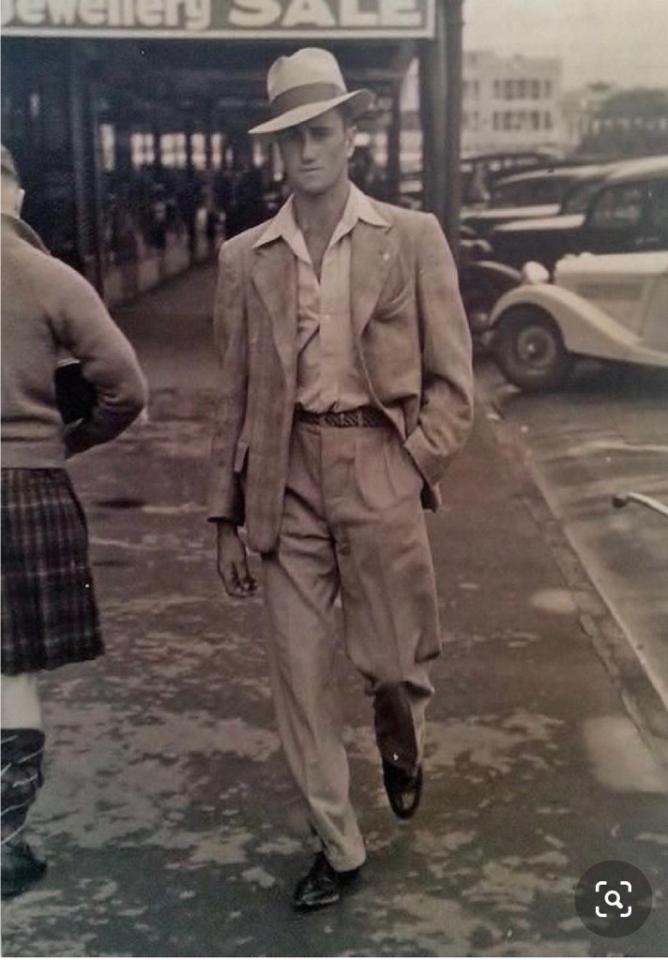
My father always kept at least three hats on it: his “every day” hat, and two “Sunday” hats–one dark and one lighter colored. During the seasons, he rotated straw for felt.
My dad was a hat man.
By the time I entered kindergarten, there were several baseball caps and at least one kid sized cowboy hat present.
His son was a cap kid.
Over time, the cap kid became a hat man, too.
I still wear caps for golf. Sometimes, a wide brimmed straw hat if the wind isn’t too bad.
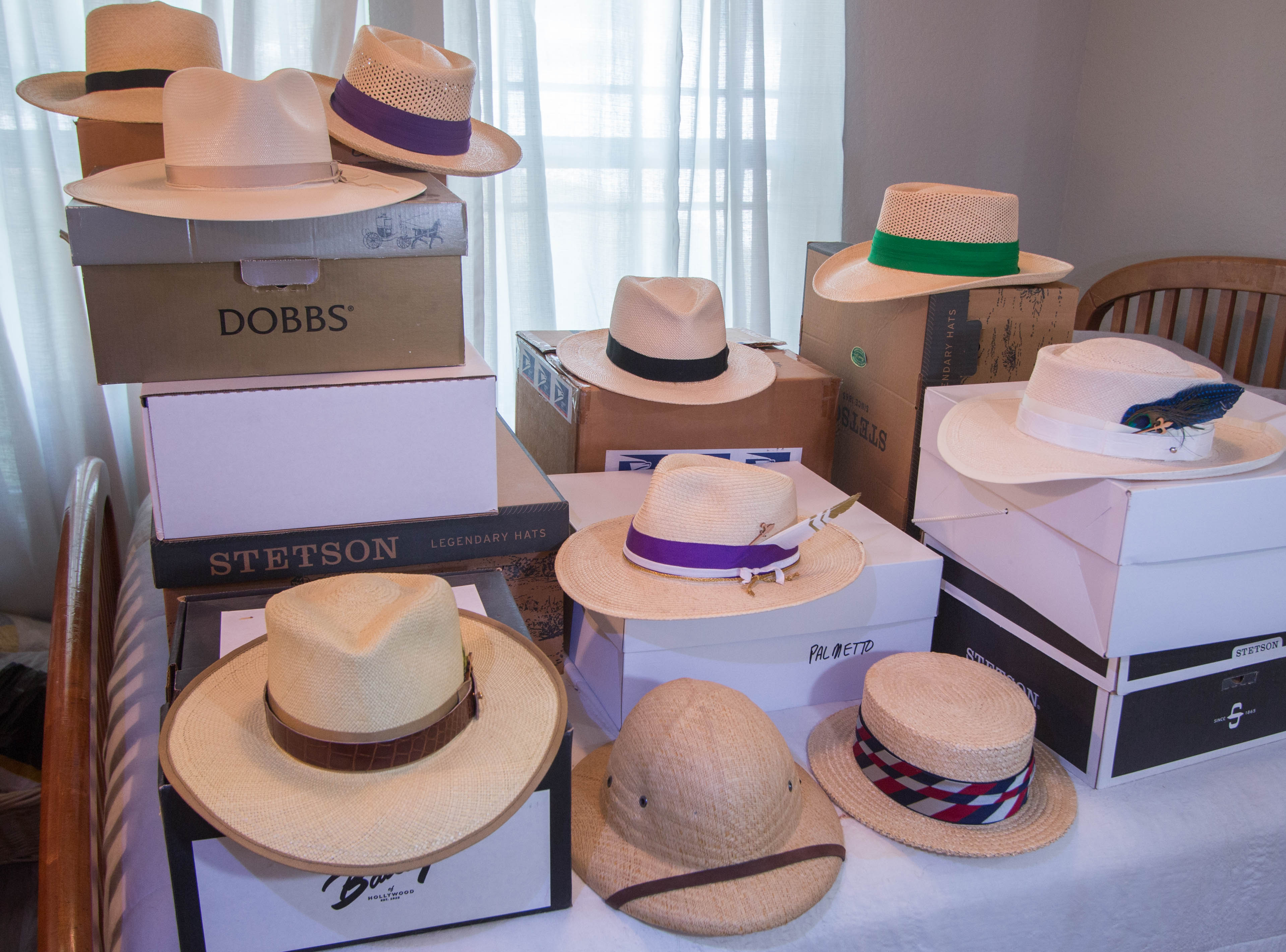
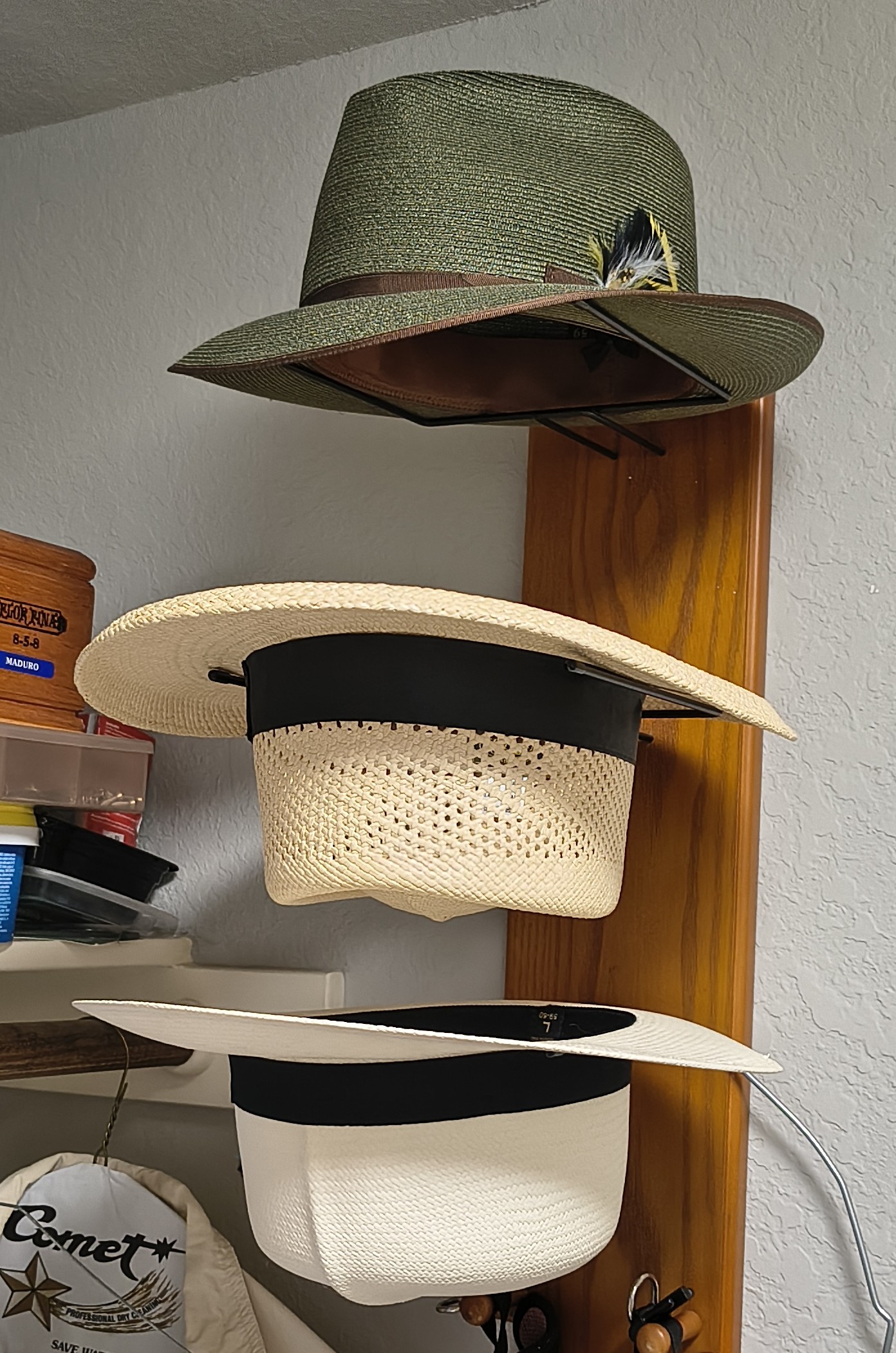
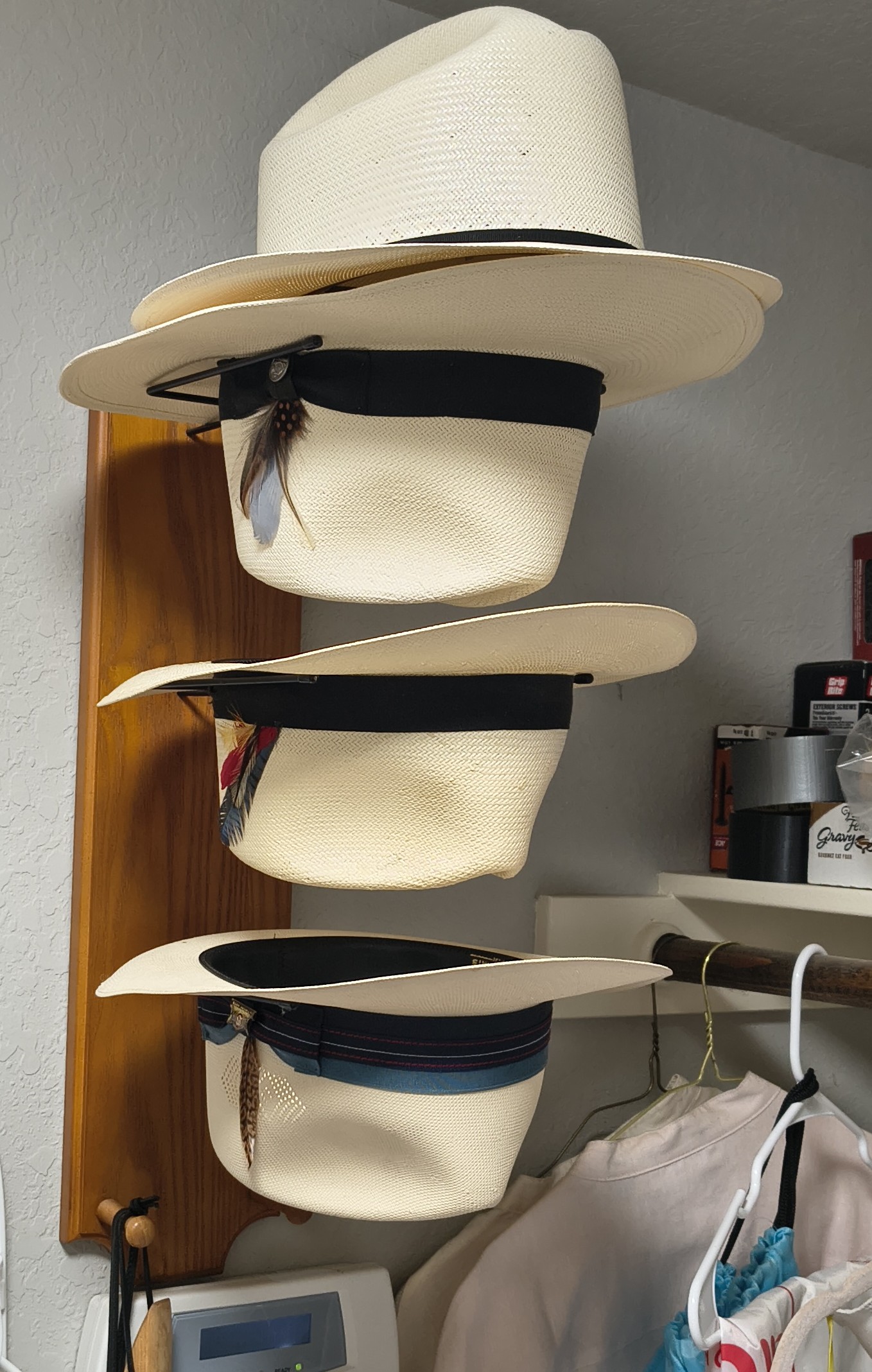
The assortment of hats in my wardrobe has grown over time. (I’m reluctant to call it a “collection” as the word implies the items won’t be used often. Every hat in my assortment is in the rotation.
The three hats behind the pith helmet and boater are custom from Colby Hebert, “The Cajun Hatter,” Lafayette, LA.
The decision of which hat to wear isn’t always easy in Texas Hill Country. A warm weather hat, straw, is appropriate and necessary about ten months out of the year. In the last four years I have purchased some custom hats and they tend to get more wear than others in the rotation.
Retirement brought me to Texas from the mountains of western North Carolina where felt hats were the choice for four or five months annually and it’s a struggle now to get them all worn every year.
To compliment the hat and tie them into the ensemble more effectively, a variety of hat bands and feathers are kept handy.
Hat etiquette is a good topic for another article, however, it’s noteworthy to state now that wearing a cap backwards, or in any direction with a suit, is anathema to me. Few sartorial faux pauses are worse.
On one of our trips to buy my father a new hat, I wore an Alpine hat my cousin had sent me from Germany. The hat salesman taught me how to wear it. He said, “Tilt it down on the side until it barely touches the top of your ear, and tilt it forward to just above your eyebrow.” I still wear my hats that way decades later. My posts online often get comments about the rakish tilt. Many consider it to be stylishly confident, and I agree.
I wear a hat or cap every day now. If I ever walked out of the house without a hat, well, that would be something I could never explain.
Disclaimer: Some of this content is hearsay–Southern (not urban) legend. It makes enough sense to me to be believable.
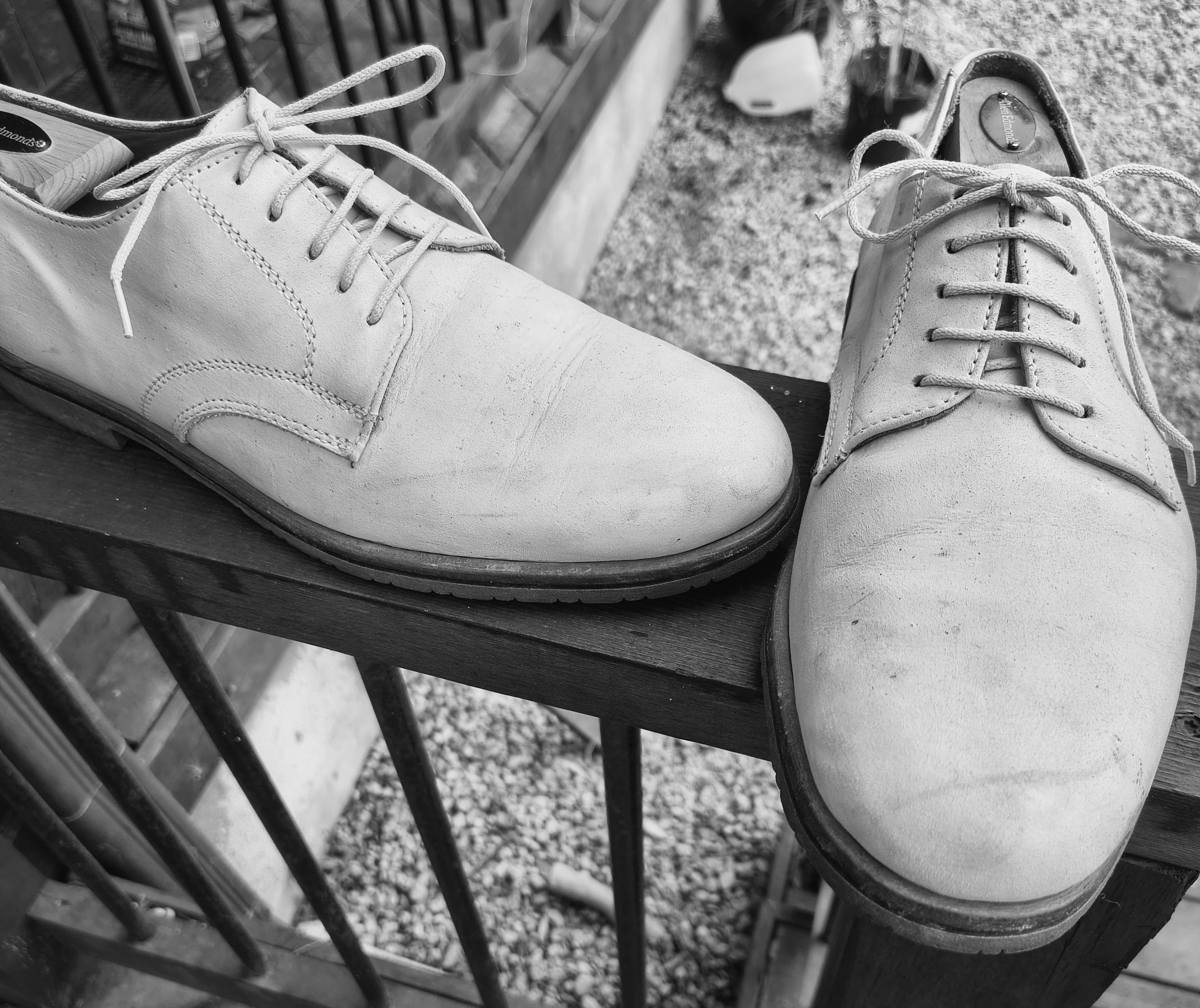
In the 1950s, white bucks were often worn by the financial and business elites on Wall Street and also by gentlemen of the best law firms. Most of these guys came from the Ivy League schools in the Northeast. A common combination included a navy blazer, white trousers, and pristine white bucks.
Young men in the schools of the Southern Ivy League (Duke, Emory, Tulane, Rice, to name a few) got wind of the trend and, true to the rebel/renegade reputation they enjoyed, started wearing white bucks that were anything but pristine. Black scuff marks, scratches, small rips or tears, added character and charm to the shoes. It caught on quickly and still can be seen today, a style choice kept alive by men who still behave like the rebels of their heritage.
Therefore, when you see a gentleman wearing dirty white bucks, don’t scoff or shake your head in dismay. Simply be aware he’s still a renegade who’s proud of his reputation and isn’t neglecting his shoes.
Pennsylvania said “No” to independence. On May 1, 1776, voters turned out and in the nearest thing to a referendum on independence, voted it down. In reality, they voted for a form of state government that in and of itself precluded support of the colony’s representatives to the continental congress for independence. It had been a long and difficult battle for John Dickerson. It marked the beginning of a series of behind-the-scenes meetings and actions by Samuel Adams that could be considered nothing short of a conspiracy to declare independence.
Two hundred fifty years later, we’re still struggling with some of the same issues that delayed the union of the colonies right up until the final vote on July 2, 1776. Yeah, it was July 2, not the 4th that we declared independence. Voting rights, racism, slavery, dramatic differences in economic levels, roots of labor unions, back-room deals, and petty bickering amongst the elite, rich ruling class made me check today’s calendar against the setting of the absorbing and eye-opening Declaration — the Nine Tumultuous Weeks When America Became Independent: May 1 – July 4, 1776 by William Hogeland. Before Hogeland’s educational romp through the last nine weeks before July 2, 1776, many thought that Huey P. Long, Louisiana, and New Jersey politics took the cake. True to the old adage about newness under the sun and FDR’s comment on conspiracies, our forefathers set the pace for interesting politics in the years to come for the new republic.
“The shot heard ’round the world” was fired in Concord, Massachusetts on April 19, 1775, a full year before the election in Pennsylvania that started the dominoes falling. Pennsylvania’s leader was against independence but was an officer in the militia and an enthusiastic soldier. John Adams wanted the emerging country to be run by an elite ruling class of the wealthy with only those who owned enough property to be allowed to vote. Very few of the fighting men owned any property unless they moved to Vermont. Just as today, our country’s character is filled with interesting and important paradoxes that have led to many ironies. Reading these sometimes humorous and always interesting stories proved to me that history does in fact repeat itself, for good or bad and politics do in fact make strange bedfellows. We have to make the most of it in our own generations.
Hogeland also authored The Whiskey Rebellion, and a collection of essays, Inventing American History, as well as two plays, a co-authored screenplay, and a novel, The Surrender of Washington Hansen. He uses flashbacks and actual conversations (gleaned from diaries and historical notes) to make Declaration come alive like a novel — but this is all fact. Fifty-eight pages of notes and and another dozen for listing sources make this little known story ring true and re-assures the reader. Also included are eight slick pages of high gloss black and white photos and illustrations. Hogeland tells us the back stories of the famous like the Adams cousins and John Hancock. We are also introduced to the renegade pharmacist, the math teacher who wanted to provide for the poor, eliminate slums, and help farmers, and the self-taught medical doctor who established Vermont. Who is that flamboyant purple-dressed character with an equally flamboyant signature? Where is “Poor Richard” when you need him and who is that Southerner with the three names? How does Richard Henry Lee become such an important piece in Samuel Adam’s puzzle? As if there wasn’t enough pressure to finally decide on independence, the largest fleet in history (prior to June 6, 1944) is under sail toward the colonies to intensify the fighting begun in Concord.
Would I buy Declaration — the Nine Tumultuous Weeks When America Became Independent: May 1 – July 4, 1776? Yes — faster then you can put your “John Hancock” on a personal check!
As it turns out, John Montagu, 4th Earl of Sandwich and English estate manager Charles Cunningham Boycott have something in common. Need we continue?
Do boycotts result in forcing change? I suppose that varies with each episode.
Do they result in having an effect on a company’s business?
Yes.
If you don’t believe me, ask officials at Disney, Target, and Annheuser Busch.
Lots of people boycott different businesses for different reasons. What’s significant is how long do people continue?
In my case, there’s one company I’ve boycotted for over ten years, actually two, and for reasons of my own which are satisfactory to me.
My current list of companies I boycott is longer than my shopping list.
I find it mind boggling that as divided as our country seems to be, companies continue to tout their politics and positions on societal matters knowing full well they risk alienating almost half their customer base.
To begin our interview, let’s start with your clientele.
Who uses your services?
A. I want to represent older guys who know who they are, comfortable in their skin and relevant, not lost in a world of massive changes.
Tell us more about your brand.
A. My brand is about power and masculinity. I take a contemporary look at the golden era of Hollywood.
I found my clients were more about buying into the lifestyle of a successful rakish man, one who is aging gracefully and reinventing himself throughout each decade and stage of life. Staying relevant without being trendy.
Ah, “rakish!” I love that word, evokes thoughts of the dashing Hollywood star or jaunty renaissance man. How does it apply to your prototypical client?
A. He’s a guy with an attitude. Mostly because he’s been there and done that. No matter what “that” is. As they say this isn’t his first rodeo. He’s confident because he’s lived a life and learned thru trial and error what works and what doesn’t.
Now, give your take on two more words, “power” and “masculinity.”
A. Power and masculinity can be somewhat intermixed. Often, it’s a man’s masculinity that gives him power. But it’s not brute force. In fact, I find force offensive. One can be strong, masculine and powerful without being a brute or forceful.
What are your favorite movies for ideas about men’s wear?
Die Hard – when Alan Richman (the leader of the terrorist team) was discussing sartorial perspectives in the elevator was awesome!
Wall Street
American Psycho
Bugsy
Boardwalk Empire – HBO
Anything with Carey Grant in it
Public Enemies – inspired me to have Optimo make me a Dillinger fedora
Perry Mason – HBO
Gatsby 1974
Tucker and Sea Biscuit (Jeff Bridges basically played the same character in both films).
Godfather Part Two
Casablanca- the hat, but specifically, Rick’s white dinner jacket
What is your goal?
A. I’m creating the best dressed men in America.
How will you do that? Tell us more about what you do specifically.
A. I design wardrobes for my clients. Carefully designed and planned out with my clients image at the core of everything we do.
I focus on the individuality and rakishness of men who know who they are, what they want, and how they want to present their own unique brand.
“Brand.” Let’s consider that. I suppose you and I could wear the same navy suit, same white shirt, and same red tie and yet people would be able to distinguish our individual “brands.” How do I identify and convey my brand?
A. That can be achieved in many ways. The obvious choices could be accessories chosen or little nuances like how you wear those accessories. Or, it can be as dramatic as the individual. I live in Texas and many men will wear boots and a western hat with their suits. It’s not for everyone, but it is certainly their brand and how they’re identified. But I also look deeper. I’ll add little subtleties to someone’s choices to enhance that individual.
My background is unique. I was trained in classic menswear design but originally opted to begin my career in merchandising. After ten years, I switched careers and worked on Wall Street. As my career progressed, I started having my suits made, but never felt the tailors I used reflected my brand into my clothing. Then it hit me. I had a design background and understood the importance of creating and executing a brand, so I married the two and that’s how I began.
What makes me different from other designers, clothiers and tailors is I spent over 35 years as a professional businessman knowing how image impacts decision making and effectiveness.
Now, I help my clients leverage looks that make them more effective and confident in their lives.
Gentlemen: Have you ever had the desire to dress like James Bond?
Ladies: Would you like your male companion to rock a Bond outfit–or that of another dashing Hollywood legend?
I’m a member of several groups on Facebook with dapper/classic men’s attire as the subject.
A post caught my attention.
The article was about the gray suit worn by Bond in the movie, Goldfinger.
It was the scene in Kentucky at Goldfinger’s ranch.
Don’t get me wrong, neither my naivety nor my vanity are influential enough to make me think I would ever look as good as Sean Connery, much less attract a woman like Honor Blackman.
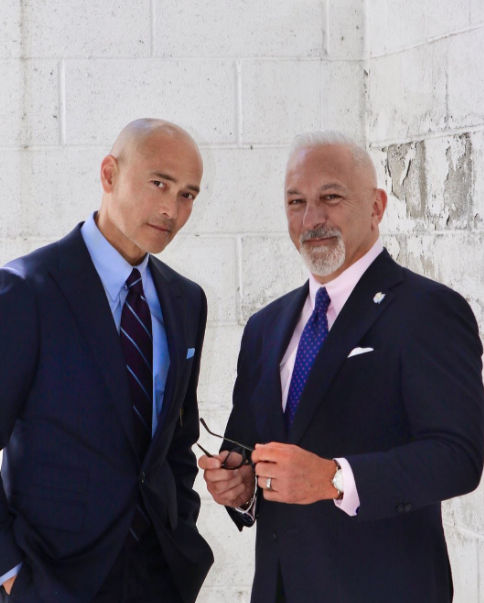
Over that last few years I have become acquainted with several of the members of these groups off line–in real life. One of them is an advisor/stylist. Neither your typical clothier, designer, nor tailor. David Ambrico really enjoys helping twenty-first century clients look their best in classic designs of yesterday. You don’t have to be a movie star to look your best.
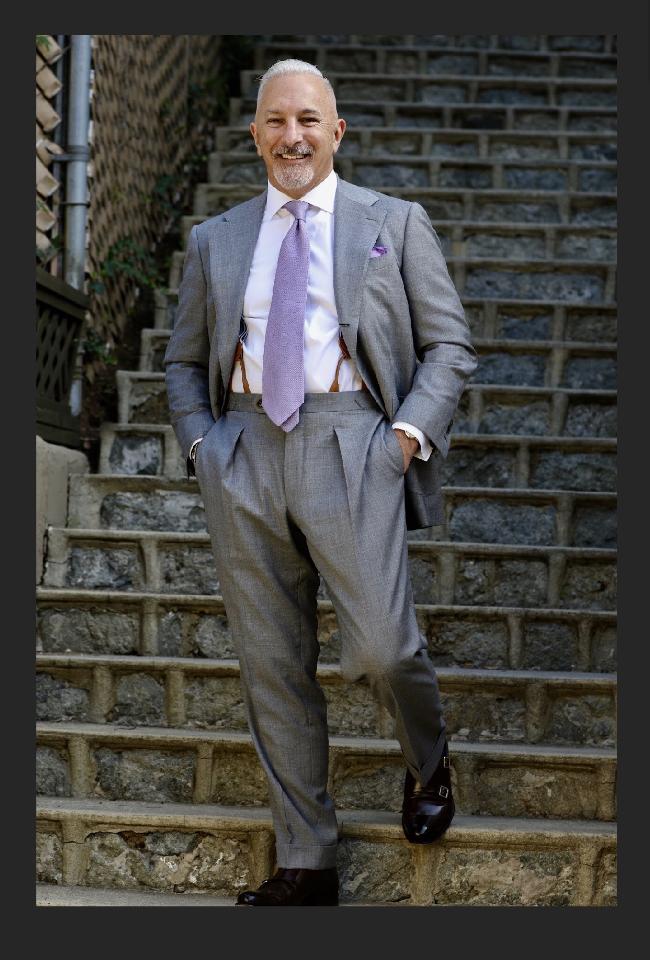
A common thread (no pun intended) in my attire is trousers with pleats, cuffs, and a hat. Ambrico likes ‘em, too.
I asked him if he could help me with the Bond/Goldfinger suit and he answered confidently, “Do you want the same color pallet?”
And so began the odyssey of my first movie inspired ensemble.
It also was the beginning of a beautiful friendship. That’s the way Ambrico works. He forms a relationship with every client, helps them make the most of their wardrobe, and customizes their attire to compliment their own unique “brand.”
His clients include actors, writers, leaders in financial services, influencers, aficionados, and a cast of characters as diverse as the swatch books he uses.
Ambrico (right) with Mark Dacascos, “Zero” in John Wick 3.
He, like I, believes that not only do clothes make the man, but the man makes the clothes look their best.
It works — and so does he.
Ambrico helped me take advantage of the clothes already in my closet before I purchased anything from him. Since we began working together, I have made smarter investments in suits, shirts, trousers, and accessories.
Now I dress with confidence in business environments, dinner meetings, and on the golf course.
Dressing well is good for my business(author and photographer.)
I’ve noticed (too many times) we often don’t know how to stand when preparing for a photo.
During my years of teaching Dale Carnegie Courses and taking photos as a professional photographer, I’ve seen subjects in somewhat less than flattering stances.
Notice in the first photo, I’m standing in what we refer to as the “fig leaf” position. It does not inspire great confidence.
The “reverse fig leaf” is no better.
So how should I stand?
It’s simple. Let your hands fall at your side. This will get them out of your way and you’ll know where they are if you need them.
While squarely facing the camera — or your audience — is perfectly acceptable, there’s an even better position. Depending on your build, this pose can give you the appearance of being a few pounds lighter.
Stand on a forty-five degree angle to the camera.
Now that you have some examples of how to stand, perhaps you can be more convincing when you talk about where you stand on any issue.
I invited Jesus into my heart and He stopped by for a visit.
I heard a knock at the front door (I rarely have visitors) and expected to find a Jehovah’s Witness.
To my surprise, it was Jehovah Himself!
“Come on in, I’m surprised to see you,” I said.
“Why,” He answered, “I’ve been here all along. Let’s have a little talk.”
We sat in my living room and had a great conversation.
“Can I offer you something to drink?”
“Communion wine would be nice,” He said with a smile.
“I’d offer you supper, but all I have is some Pepperidge Farm whole wheat bread and two pieces of leftover fried flounder from a Father’s Day dinner at the country club.”
He laughed out loud, “You KNOW what I could do with that!”
Then He added, “A glass of room temperature chianti would be nice, you do have some red wine glasses don’t you?”
“I’m charmed with your sense of humor. I knew for sure you had a good one when you matched me up with my last wife.”
He smiled again, an engaging “You’ve been forgiven and I love you smile.”
He nodded at her photograph and said, “No doubt you feel her love every day.”
“Yes, every day. Thanks for the assurance, what a blessing.”
“You know I inspired Ms. Crosby to write the hymn, “Blessed Assurance.”
“You’ve been busy inspiring us for a long time. I just finished reading a book about the Bible and I’m confident you surely inspired the authors of the original manuscripts. I’ve had my doubts about all the translations and transcriptions.”
I got the wine, poured us each a glass, and He asked with a conspiratorial wink, “Did you get it from the spigot?”
“When we moved into this house, the neighbors told us it had a good well and the water was delicious. This came from a bottle of Bell’Agio, you know the kind with the basket around the bottom?”
“One of my colleagues was hidden in a basket.”
“We have no bullrushes here in the mountains–maybe in the swamps of South Louisiana.”
“There’s a question I’ve always wanted to ask you, if you don’t mind.”
“Shoot.”
“Are you very religious?”
“Hmmm….well, I was raised Catholic. John Paul II visited New Orleans didn’t he.”
“Yes,” I answered, “back in 1987.” “Thirty-two years ago, not even a drop in the ocean the way I keep time.”
He glanced around my living room, which is really a library. Three walls are lined with books. Over the mantle is a shelf on which are some of the books that have had significant influence on my life including the Holy Bible.
There are several copies, in different versions, including one of those with what Jesus said in RED.
As His gaze lowered from the books, He turned towards me and our eyes met. We were thinking the same thing.
I said, “You can tell me how many hairs on my head, but have you read one of those red letter editions lately?”
“Not in a long while.”
“Do you have a preferred version?”
His eyes lit up and he flashed a wicked smile (Is that possible?) and said with a chuckle, “To quote some of my followers from Kentucky, ‘If the King James version was good enough for Jesus, it’s good enough for me.”
We shared another laugh and each had a sip of chianti.
I refilled our glasses.
He walked over to the shelf and picked up my large print edition, “Don’t worry, I don’t need glasses, this is the one with red print.”
“Have you ever considered doing stand up?” I couldn’t resist asking.
“You should have heard me as a teen in the synagogue! Remember, I’m Jewish. I wrote some of Dangerfield’s best material. You think that guy got no respect? Heaven, I gave him that whole schtick about no respect.”
I love this guy!
He found the New Testament and started turning pages faster than I could imagine–He reads fast!
Every now and then, He would stop, point to a passage and exclaim, “I never said that!”
“Or that.”
“Or this one. Unbelievable!”
“I’ve been misquoted.”
I was stunned. “Your saying something got lost in translation?”
“I bet you didn’t know I wrote most of the script for that movie. Bill Murray is one of my favorite actors, well, and of course, Charlton Heston.”
Then He continued, “Are you familiar with the word, ‘gnostic?”
“Yes,” I said. “It comes from the Greek word, ‘gnostos’ when meant, ‘known.’ Today we use ‘gnostic’ to refer to knowledge.”
“Very good, Chip. Now, on a related topic, I’m sure you’re familiar with a collection of items being symmetrical, such as both sides of a building. What happens if you add the prefix, ‘A?’”
“It becomes asymmetrical, without symmetry.”
“Put that same letter in from of gnostic and you’ve got a category of folks who don’t know what to believe.”
“Agnostic.”
“Looking through this revised new English jive version of what’s happening now, it’s no wonder there are so many agnostics in the world–they don’t know what to believe!”
I was speechless.
He could tell by the expression on my face.
We stood, He placed His hand on my shoulder, and said, “Just remember what John and Paul said because they got it right.”
I asked, “The Apostles?”
“No, the Beatles. All you need is love. I am love. Peace be with you Chip.”
He turned and although He left the room physically, I know He’ll always be close.
(Bible quotations for this article are all from the King James Version distributed by the Gideons.)
John 19:14, “And it (the day of crucifixion) was the preparation of the passover…”
Jesus appeared before Pilate, is ordered to be executed, and is taken off and crucified.
But wait,
the author of the Gospel known as, “Mark,” writes in Chapter 14:12, “And the first day of unleavened bread, when they killed the passover (lambs), his disciples said unto him, ‘Where wilt thou that we go and prepare that thou mayest eat the passover?’”
And then in verse 18, “And as they sat and did eat, Jesus said, ‘Verily I say unto you, One of you which eateth with me shall betray me.”
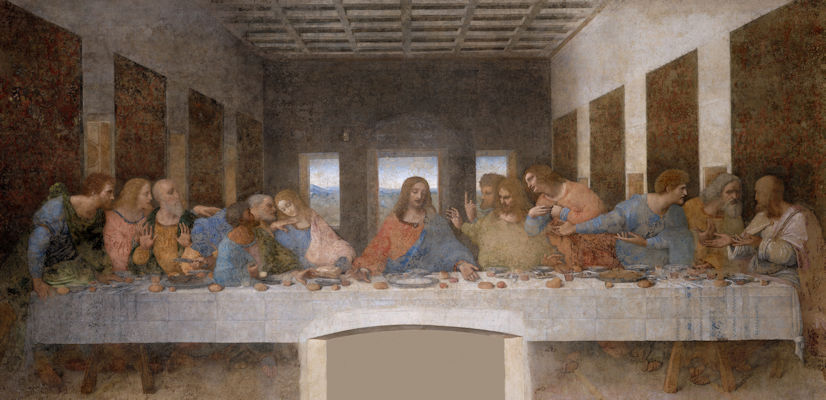
Hmm…According to this writing, Jesus clearly survived the day of the preparation because he ate the Passover meal with his disciples (the Last Supper) in the “Upper Room.”
Image credit: wikicommons
One possible reason for this obvious discrepancy,
according to Bart D. Ehrman,Ph.D., Professor of the Department of Religious Studies at the University of North Carolina, Chapel Hill, “Is it possible that John has changed historical data to make a theological point, that he’s changed the day and hour of Jesus’ death precisely to show that Jesus really was the Lamb, who was slain on the same day and at the same hour (and at the hands of the same people–the chief priests!) as the Passover lamb?” This explanation would confirm the identification of Jesus as “the Lamb of God which taketh away the sins of the world.” John 1:29, 36.
Should discrapancies between Gospel accounts be considered “errors?”
Does it matter to you if the accounts of the New Testament are historically accurate?
It does to me, for reasons of my own, which are satisfactory to me.
My desire to eliminate this “So” thing began a few months ago.
In spite of my efforts to avoid it, I still catch myself.
It was beginning to seem as if I was alone in my disdain for a pernicious speech pattern taking the country by storm.
Easy to have such a perception when so many people have succumbed to what I consider a lazy sentence construction.
It’s even begun to appear in the printed word. [sigh] And from presumably otherwise intelligent reporters and pundits on TV.
It’s almost as bad as that unnecessary “that,” or “like.”
When it comes up on conversation, it’s been pleasing to discover others share my concern. It’s almost as bad as not teaching cursive writing in elementary school. How does a kid sign his/her name? (Another topic for another blog.)
A quick check of the thesaurus reveals a number of alternatives and in many cases it seems “so” is nothing more than a filler for a silent pause. It’s an unnecessary segue to the next sentence.
Just say what you want and get on with it.
Silent pauses are preferable and most of the time, much more effective.
I first began to notice this construction when my boss called me. As usual, the call began with preliminary pleasantries. Then a “so-pause.” He would say, “So…..” and I knew the reason for his call was about to be revealed.
My favorite substitutes are “aaaaahhhh” and, “ummmmmm.”
Mike Sitton of the Asheville Toastmasters confirms that in addition to “aahs,” they also make their speakers aware of “so” and other unnecessary “filler” words. They use a clicker or a horn. Maybe we could all use verbal reminders. (I bet the Toastmasters club in Starkville, Mississippi uses a cow bell.)
We’ve discussed this at work. I asked my co-workers to stop beginning a sentence with the word, “so.” I’ve begun responding by saying, “No so!”
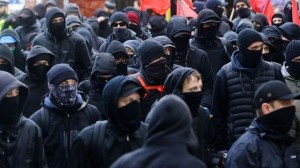
To this point, no one has complained I’m violating their first amendment rights. Hopefully, none of them show up at work with a black ski mask and a baseball bat.
Which reminds me. Maybe I’ll create a group to fight this “so” usage and crusade for more appropriate speech.
I’ll name the group, “Anti-SO” and see if I can get major funding from a guy whose name begins with “SO.”
 July 25, 2026
 FCEtier







 To this point, no one has complained I’m violating their first amendment rights. Hopefully, none of them show up at work with a black ski mask and a baseball bat.

