Posts tagged ‘history’

Book review: Declaration by William Hogeland

Pennsylvania said “No” to independence.  On May 1, 1776, voters turned out and in the nearest thing to a referendum on independence, voted it down.  In reality, they voted for a form of state government that in and of itself precluded support of the colony’s representatives to the continental congress for independence.  It had been a long and difficult battle for John Dickerson.  It marked the beginning of a series of behind-the-scenes meetings and actions by Samuel Adams that could be considered nothing short of a conspiracy to declare independence.

Two hundred fifty years later, we’re still struggling with some of the same issues that delayed the union of the colonies right up until the final vote on July 2, 1776.  Yeah, it was July 2, not the 4th that we declared independence.  Voting rights, racism, slavery, dramatic differences in economic levels, roots of labor unions, back-room deals, and petty bickering amongst the elite, rich ruling class made me check today’s calendar against the setting of the absorbing and eye-opening Declaration — the Nine Tumultuous Weeks When America Became Independent: May 1 – July 4, 1776 by William Hogeland.  Before Hogeland’s educational romp through the last nine weeks before July 2, 1776, many thought that Huey P. Long, Louisiana, and New Jersey politics took the cake.  True to the old adage about newness under the sun and FDR’s comment on conspiracies, our forefathers set the pace for interesting politics in the years to come for the new republic.  

“The shot heard ’round the world” was fired in Concord, Massachusetts on April 19, 1775, a full year before the election in Pennsylvania that started the dominoes falling.  Pennsylvania’s leader was against independence but was an officer in the militia and an enthusiastic soldier.  John Adams wanted the emerging country to be run by an elite ruling class of the wealthy with only those who owned enough property to be allowed to vote.  Very  few of the fighting men owned any property unless they moved to Vermont.  Just as today, our country’s character is filled with interesting and important paradoxes that have led to many ironies.  Reading these sometimes humorous and always interesting stories proved to me that history does in fact repeat itself, for good or bad and politics do in fact make strange bedfellows.  We have to make the most of it in our own generations. 

 Hogeland also authored The Whiskey Rebellion, and a collection of essays, Inventing American History, as well as two plays, a co-authored screenplay, and a novel, The Surrender of Washington Hansen. He uses flashbacks and actual conversations (gleaned from diaries and historical notes) to make Declaration come alive like a novel — but this is all fact.  Fifty-eight pages of notes and and another dozen for listing sources make this little known story ring true and re-assures the reader.  Also included are eight slick pages of high gloss black and white photos and illustrations.  Hogeland tells us the back stories of the famous like the Adams cousins and John Hancock. We are also introduced to the renegade pharmacist, the math teacher who wanted to provide for the poor, eliminate slums, and help farmers, and the self-taught medical doctor who established Vermont.  Who is that flamboyant purple-dressed character with an equally flamboyant signature?  Where is “Poor Richard” when you need him and who is that Southerner with the three names? How does Richard Henry Lee become such an important piece in Samuel Adam’s puzzle?  As if there wasn’t enough pressure to finally decide on independence, the largest fleet in history (prior to June 6, 1944) is under sail toward the colonies to intensify the fighting begun in Concord.

Would I buy Declaration — the Nine Tumultuous Weeks When America Became Independent: May 1 – July 4, 1776?  Yes — faster then you can put your “John Hancock” on a personal check!  

It makes great reading for the second of July.

Book Review: Secrets of the Dead by Caleb Pirtle

“Through the travail of the ages                Image

Midst the pomp and toil of war

Have I fought and strove and perished

Countless times upon this star.


So as through a glass and darkly

The age long strife I see

Where I fought in many guises,

Many names – but always me.”  — George S. Patton


General Patton believed in reincarnation.


Ambrose Lincoln has lived it.


How many lives has he lived? No one knows. Countless times upon this star.


Not even he knows how many times he has lived and died.


As a result of his peculiar circumstance, Mr. Lincoln has no fear of death whatsoever.


Everyone will die with secrets.


When Ambrose Lincoln dies, he will carry many secrets to the grave with him.


But he won’t remember any of them in this life.


Lincoln is the central character in Secrets of the Dead, Caleb Pirtle’s most recent offering. Pirtle is the author of over sixty books and long recognized as one of America’s great story tellers.


November 1938 is the setting for Secrets of the Dead. It was known as “Kristallnacht.” It was a night of horror in Poland. A night of broken glass, broken hearts and broken promises.

Kristallnacht would likely have been the “Gulf of Tonkin” for America’s involvement in World War II had it not been for Pearl Harbor.  Either event alone would have begun the cascade of events that brought the Yanks into the European war. Together, they assured American involvement and doom for the Axis Powers.


Kristallnacht would precede and create the venue for Ambrose Lincoln’s next assignment. He wouldn’t remember it for very long.

Image

Rare color image from WWII found in a book we recently reviewed: “America At War in Color.” Click on the image to read the review in a new window.

Pirtle takes readers back in time to the climax of events that created World War II. From the rubble in Jewish ghetto streets to the hallowed halls of power in Washington. We experience the power of politics, hate, war, redemption and love via an unforgettable cast of characters. In addition to the assassin pawn, Lincoln, we meet his handlers, his masters and several Germans who share the misfortune of his company. We know that not everyone we meet will live to the last page.

Another character of interest is a natural element, snow. The ever-present snow erases evidence of footsteps and meetings. It seals the secrets of the dead.

Secrets of the Dead debuted as a daily serial on Venture Galleries’ web site. Venture Galleries is a leader in bringing serial novels back into the mainstream. Any given day, readers will find up to a dozen serials in progress with an eclectic variety of genres from thrillers and romance,  to historical novels, politics, and murder. All chapters are archived on the site and available anytime. So, settle down in your easy chair with your online reading device and enjoy a quick interesting read.  Secrets of the Dead is a great place to start.

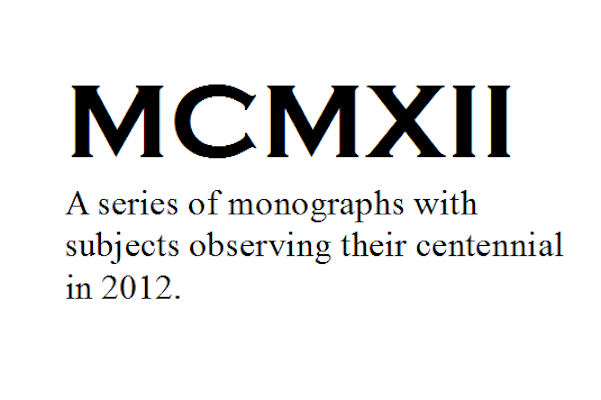
MCMXII

MCMXKK is simply 1912 in Roman numerals.  

A few days ago, I finished reading (re-reading actually) an old favorite book: The Lost World by Sir Arthur Conan Doyle.  Many readers will remember him more for the Sherlock Holmes series.

He also wrote this great book upon which Michael Crichton later drew inspiration for some of his works.

I noticed that The Lost World dates back to 1912.  Then today, while researching THIS ARTICLE on ways to control your attitude, I discovered that Dale Carnegie Training started in 1912 also.

Since I’m the National History Examiner for Examiner.com it only stands to reason that I should begin a series of articles related to subjects which observe their centennial year in 2012.

Watch for the first article in that series AT THIS LINK, soon.  It’s a good bet that it will begin before the first of the year.  I also hope you will consider clicking on the “Subscribe” button near my avatar on the “Profile” page.  Happy reading and happy new year!

MCMXII – 1912

MCMXII - 1912

Logo for my series on centennial subjects for 2012.