Folkmoot U.S.A. Celebrates Thirty Years in 2013

Beauty, talent, and native music combine to make Folkmoot USA a unique international festival. In fact, it has been named the North Carolina “State International Festival” and annually attracts over 100,000 visitors to the Western end of the state.  It also has the distinction of having been named a “Top Twenty Event in the Southeast.”


The 2013 edition will mark the thirtieth annual celebration of cultures from around the world.  Each year troupes of singers, dancers, and musicians from as many as a dozen countries converge in Waynesville, NC to share their cultural heritage.  In addition to their performances, there are many opportunities for the performers to meet the locals, get acquainted, and learn about their host country.


On Saturday, April 27, 2013, the Huffington Post reported that in 2012, the Great Smoky Mountain National Park led all national parks with over 9.6 million visitors. The most visited area of the National Park System was the Blue Ridge Parkway, with over 15.2 million visitors. Both attractions are easily accessible from the mountain hamlet of Waynesville.


Waynesville (population est. 10,000) is located in the Great Smoky Mountains between Asheville, NC and Knoxville, TN.  It is a popular tourist destination year-round, especially for Folkmoot and the changing of the leaves in autumn.  Located near the Cherokee Indian Reservation the Waynesville area features many other nationally popular venues, such as the Wheels Through Time Motorcycle Museum in Maggie Valley. Stay in or near Waynesville and you’ll be a short ride from Deal’s Gap and the world famous Tail of the Dragon.


The performers from each country participate in an opening parade, numerous public and private performances, workshops, and the closing candlelight ceremony at Lake Junaluska.  This year’s festival features invitees from France (Stilt-Walkers), Martinique, Thailand, Japan, Slovakia, Mexico, Canada (Scottish Highland Dance) and Paraguay.


Art Hoffman, recently named one of Folkmoot’s official videographers for 2013, will be on hand to document the celebration, many of the performances, and some “behind-the-scenes” action. Over the last few seasons, Art’s video clips have documented this unique event and attracted over 11,000 views. One of his best features the Burundi dancers in their 2011 appearance in which they invited audience members to dance with them. If you appear in this video, Art will promise to include you in one of his videos this year at the Saturday International street fair on July 20, 2013.


Art is part of a contingent that comes to Folkmoot each year from Louisville, KY. This year that group will likely number close to 20 (ethnic dancers all) who will be attending the festival; it is estimated these fabulously flush Folkmoot fans, farm  fresh from the Kentucky Derby will pump between one and two billion dollars into the local Waynesville economy.


While details of the performances may fade with time, I enjoy photographing the faces of both performers and audience members.  Whether the charm of a cute smile or the confidence of a regal glance, the Faces of Folkmoot are unforgettable.


Folkmoot 2013  runs from July 17 – 28. More details are available from the Folkmoot website, HERE.

Book Review: Secrets of the Dead by Caleb Pirtle

“Through the travail of the ages                Image

Midst the pomp and toil of war

Have I fought and strove and perished

Countless times upon this star.


So as through a glass and darkly

The age long strife I see

Where I fought in many guises,

Many names – but always me.”  — George S. Patton


General Patton believed in reincarnation.


Ambrose Lincoln has lived it.


How many lives has he lived? No one knows. Countless times upon this star.


Not even he knows how many times he has lived and died.


As a result of his peculiar circumstance, Mr. Lincoln has no fear of death whatsoever.


Everyone will die with secrets.


When Ambrose Lincoln dies, he will carry many secrets to the grave with him.


But he won’t remember any of them in this life.


Lincoln is the central character in Secrets of the Dead, Caleb Pirtle’s most recent offering. Pirtle is the author of over sixty books and long recognized as one of America’s great story tellers.


November 1938 is the setting for Secrets of the Dead. It was known as “Kristallnacht.” It was a night of horror in Poland. A night of broken glass, broken hearts and broken promises.

Kristallnacht would likely have been the “Gulf of Tonkin” for America’s involvement in World War II had it not been for Pearl Harbor.  Either event alone would have begun the cascade of events that brought the Yanks into the European war. Together, they assured American involvement and doom for the Axis Powers.


Kristallnacht would precede and create the venue for Ambrose Lincoln’s next assignment. He wouldn’t remember it for very long.

Image

Rare color image from WWII found in a book we recently reviewed: “America At War in Color.” Click on the image to read the review in a new window.

Pirtle takes readers back in time to the climax of events that created World War II. From the rubble in Jewish ghetto streets to the hallowed halls of power in Washington. We experience the power of politics, hate, war, redemption and love via an unforgettable cast of characters. In addition to the assassin pawn, Lincoln, we meet his handlers, his masters and several Germans who share the misfortune of his company. We know that not everyone we meet will live to the last page.

Another character of interest is a natural element, snow. The ever-present snow erases evidence of footsteps and meetings. It seals the secrets of the dead.

Secrets of the Dead debuted as a daily serial on Venture Galleries’ web site. Venture Galleries is a leader in bringing serial novels back into the mainstream. Any given day, readers will find up to a dozen serials in progress with an eclectic variety of genres from thrillers and romance,  to historical novels, politics, and murder. All chapters are archived on the site and available anytime. So, settle down in your easy chair with your online reading device and enjoy a quick interesting read.  Secrets of the Dead is a great place to start.

Interview with Charles Long, retired opera star

When was the last time you listened to opera?
I pointed out in a recent book review that it was a champagne commercial back in the eighties that got me hooked.

Then, I started listening during football games.

My review of Adventures in the Scream Trade got such favorable attention and widespread interest, it seemed like a good time to interview the author, Charles Long. It turned out to be a great idea.

Long, now retired, is not one to be tied down by a house. He’s now a “Snow Bird,” migrating from the Sonoran Desert in the winter to the Cascade Mountains of the Pacific Northwest in the summer. His possessions are limited, lightweight and portable, but he doesn’t compromise on priorities.
Long hasn’t owned a television in more than a decade.
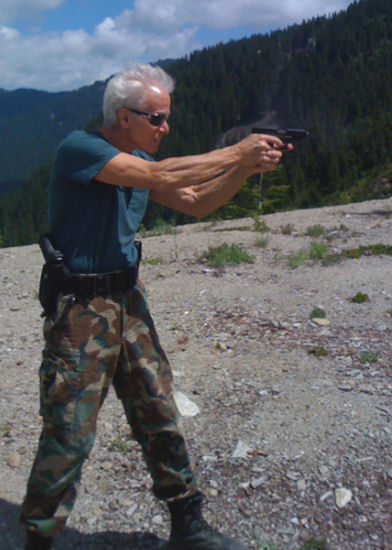
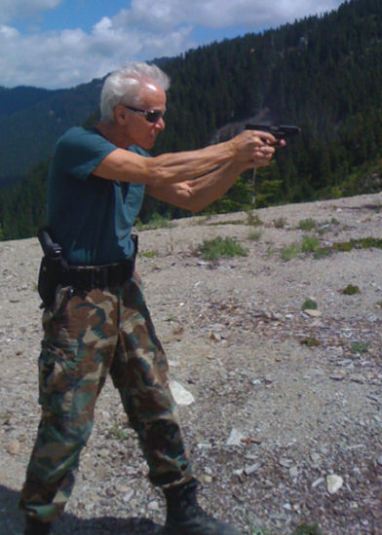
He keeps a thousand rounds of ammunition for each caliber he uses.

We caught up with him last week near Scottsdale, Az, via Skype and had an enlightening chat with him.

We found him to be gregarious, friendly, and animated.

He’s outspoken, clear, and committed to his principles.Image
What prompted you to write “Scream Trade” and what inspired the title?

I began writing “Scream Trade” under another title seventeen years before it was published. What began as a quasi-academic dissection of classical music transmogrified into a therapeutic catharsis that helped me cope with the sudden end of my career. I wanted to discuss the inner workings of the art form as well as share anecdotes from my years on the stage. But I soon realized that it was impossible to create a rigid timeline, so I used the personal stories as hinge-pins, writing the chapters as a series of short vignettes – like scenes from a movie – and tied them together with a thin autobiographical thread. Thus the subtitle, “Scenes from and Operatic Life.”

I realized I had an opportunity to reveal facets of the business that were rarely, if ever, discussed. I was determined not to write another dreary, sycophantic epic glamorizing the classical music industry. There are enough of those. Rather, I wanted to write a book that revealed the gritty underbelly of the business. “Scream Trade” is my “Pulp Fiction” realization of the opera world.

While writing one of the early drafts I was in the midst of reading William Goldman’s, “Adventures in the Screen Trade” – a wonderful book about his years as a screen writer. Since I had always described opera as “controlled screaming,” I decided “Adventures in the Scream Trade” would make a clever and compelling title.

You sang a wide variety of operatic roles. Which were your favorites and why?

Although I was sometimes considered too slim and handsome to play villains, I relished performing the Verdi and Puccini antagonists – the marvelously dark, brooding characters. Skeptics would said, “Why would Tosca choose Cavaradossi when instead she could choose a Scarpia who looked like you?” But this contradiction made the characterization all the more interesting.

One of the most chilling bad guys ever portrayed on the screen was Burt Lancaster in the 1954 movie Vera Cruz. You don’t get better looking than Burt in his prime, and he used this to wonderful advantage. He would flash a dazzling smile one minute, and do something monstrous the next. It was extremely effective. In fact, I based my characterization of Jack Rance in La Fanciulla Del West – sometimes called the “Cowboy Opera’” – on Lancaster’s portrayal of Joe Erin.

Certainly my favorite acting roles were Scarpia, Jack Rance, Rigoletto, Tonio and Don Giovanni. But as far as singing goes nothing compares with the Verdi roles, especially Macbeth, Ezio in Attila, Count Di Luna in Trovatore, Don Carlo in Forza.

What advice do you have for the “opera novice?” Someone interested in finding out more about opera?

It’s easier today. So many cuts are available on YouTube — start there. Listen to excerpts, maybe a few arias, and see what appeals to you. Then experiment with a CD of a complete opera, preferably a one act opera. Get comfortable with it before going to the theatre. Once you get past the one act operas, consider La Boheme. You’ll find out more about it and other operas in the back of my book.

You’re very hard on critics, among others, in your book. How have reviewers and former colleagues responded to your unabashed opinions?

I’m finding that the critics who like my book tend to share my political and philosophical views. They appreciate the candidness and my willingness to be provocative. But those who bow to the gods of political correctness generally find the book unsettling. As one reviewer said, “Long is willing to write what others think, but dare not say.” I like that. You have to be courageous to be a good writer. If you get caught up in second-guessing which word or thought might offend someone, you’ll never complete a book. And if you do, it’s likely to be dull.

Interestingly, feedback from my former colleagues has been almost unanimously spectacular. Sometimes they’ll say, “Wow – I can’t believe you wrote that!” Then they usually follow it by saying, “I applaud your courage.” I didn’t go out of my way to be caustic – I simply called it like it was and described circumstances as they happened, but I never minced my words when doing so.

You write exceptionally well, but you were trained as a musician, not a writer. Where did you acquire those exceptional skills?

I’ve always written – letters to the editor, articles about things that interested me, or essays on topics of the day. I’ve always found it easier to express myself by way of the written word. Only after I’ve written my thoughts on the page can I fully articulate them. Associates sometimes become frustrated because I prefer communicating via email rather than by phone. There’s something about the impromptu nature of a phone conversation that unsettles me. I can’t always find precisely the right words. For me, it’s all about finding the right word.

I’m also fascinated by the music within language. My partner and I often read to each other and marvel at the immaculate symmetry of a perfect sentence. She’s a writer as well, and sometimes we find the rhythm of a great paragraph so thrilling that we’ll read it a dozen times. Good writing is like music to my ears. Through fastidious self-education and a love of words I have been able to substitute music with writing as my creative outlet.

I went about learning how to write in the same way I mastered singing, conducting, and orchestration. I used the disciplined curiosity of a classical musician to study examples of artists I admired. I’d find the essence of each and consolidate them into an ideal, synthesizing and infusing it with my own gifts to create something unique. Somehow I have always been able to break the fundamentals of a discipline into its smallest common denominator, reassemble it, and make it my own. I discovered that I could do this with almost anything I set my mind to – including writing. A bit of talent helps, too.

Because “Scream Trade” was seventeen years in the writing, I had a long time to create a style. But what really honed my writing skills was two years in south Florida working as a sports writer covering boxing. It forced me to embrace the old actor’s axiom that “less is more,” and I developed a terse, crisp style that melded nicely with my lofty, sardonic prose.

You were trained as a musician and an instrumentalist before you turned to singing. Has that training helped you? Would you recommend such training for singers?

Absolutely! Nothing can substitute for a solid musical background and attaining some level of excellence with another instrument, especially piano. Singers are often the least skilled within the musical world. I would urge young singers to help break that stereotype and make the serious study of music their priority. As I said before, the regimented discipline of a classical musician can be applied to many things in life. Time spent in the pursuit of excellence is never wasted.

Opera fans usually have their favorite works and a list of operas they can’t stand. Which operas do you put into those two categories and why?

One can find some redeeming tune or moment in most operas, but works like Alban Berg’s “Lulu” and some of the other twelve–tone abominations move quickly to top of my Hate List. It’s not a prejudice against modern opera – I like the twentieth century works of Hansen, Bernstein, Menotti, Flloyd and Ward, among others, and I absolutely adore transitional works like Stephen Sondheim’s “Sweeney Todd.” But the painful, atonal drek of the Germans from the last century makes me want put a 45-caliber slug through my speakers. Lock n’ Load, Baby!

You seem to have very eclectic interests. It’s not every day that one encounters an opera singer who’s also a boxing fan. How did that happen?

I was raised in rural western Pennsylvania where my grandfather was Chief of County Detectives, a sports writer for the Pittsburgh Post-Gazette, a wire editor for the Butler Eagle, and had his own talk radio show about hunting and fishing long before shows of that type were prevalent. Writing and eclecticism runs in my line, I suppose.

My father and I had “Father & Son” boxing gloves, and I was awakened to the world of pugilism before I could ride a bicycle. A great love for the sport of boxing grew out of these early experiences. There are many Darwinian lessons to be learned from boxing and other sports that can help you succeed in a competitive world. I would sometimes stop rehearsal to watch an important fight on a tiny “Watchman” that traveled with me wherever I went. I would throw gigantic boxing parties where my guests could watch pay-per-view fights on three different televisions located around the house. After my retirement, while living in Miami, I followed in my grandfather’s footsteps and became a sports writer covering boxing in South Florida.

I’m sad about the way boxing has changed. I once wrote an essay called, “Where Has All the Boxing Gone, Long Time Passing?,” mourning the circumstances that have transformed it from a sport for the common man – once covered extensively on network television – to a high stakes game found almost exclusively in the realm of pay-per-view.

In your book you mention “the Desert Classic Action Shooting Competition,” and searching “for ammo brass, like a leprechaun struggling to remember where he stashed his pot of gold.” You refer to your Irish descent more than once, but are you also a shooter?

Indeed, I am both. Although I’m officially Irish-German – and a little something as yet undefined – I’ve always felt that the Muse who speaks to me from the repository of my genetic memory probably speaks Gaelic. And the stereotype of the scrappy, hardheaded Irishman who likes to occasionally tilt the bottle certainly fits me to a T.

I got my first NRA marksmanship certificate when I was about ten years old and I’ve been an avid shooter ever since. One of my earliest memories is of fondling the double-barreled shotgun hidden in my Grandfather’s bedroom closet. It was one of the most fascinating things I’d ever seen. Giggling, I would drag it into the living room as everybody ducked for cover. Many fond hours of my childhood were spent shooting tin cans and strolling through the Pennsylvania countryside with a gun on my hip, or over my shoulder. In those days gun ownership was a common, nearly ubiquitous circumstance in American life and it was accepted with ease. Sadly, attitudes toward firearms have changed, but I still do my part to preserve this essential liberty with a Life Membership in the National Rifle Association and by writing for various firearms publications. I’ve done some competitive shooting over the years, mostly IPSC, IDPA and Three-Gun competitions, and I hold concealed pistol licenses in multiple states. I take my right of self-defense and my Second Amendment responsibilities very seriously.

I’m also a computer geek and feel as though I have single-handedly kept Apple in business for decades with my recommendations and purchases. None of the writing I’ve done would have ever have been completed if I’d had to contend with pen and paper. As far as I’m concerned, the world would come to an end without my beloved MacBook and iPhone.
My other hobbies include hiking, rock-climbing, canoeing, kayaking and anything with an element of danger. I’ve even jumped out of a plane at 13,000 feet!

Considering the diversity of your interests, especially guns and shooting, it only stands to reason that you might be a bit conservative in your beliefs. Would you care to comment on your political position?
Sure! I don’t mind talking politics at all.
I’m to the right of Thomas Jefferson, over there with Patrick Henry.
My mother is a leftist and my father, a World War II vet, leaned left, but often voted Republican. My grandfather was very pro-gun and did a radio talk show back in the 50’s. In fact, some of my earliest memories involve going shooting with him.
Viet Nam was raging when I was in college. I didn’t agree with the war but still, I was a patriot. The biggest change for me, politically, happened when I moved to New York City, that bastion of political progressivism.
It’s ironic. Living in New York actually re-enforced and solidified my commitment to conservative thinking. In fact, I voted for the first Libertarian candidate for mayor of New York City.  I observed the failure of progressivism. I saw people paralyzed by fear. They didn’t want to get involved. It was too easy just to let the government do everything for them.
Most artists I was around had lived in big cities or had been seduced by progressivism. They had idealistic, cloistered lives. Many of their beliefs came from the notion that everyone had similar life experiences.

Did your political position cause you any problems with your career?
No. I have no perception that it did, because politics was rarely discussed. Being outspoken caused me problems and that most likely was an outgrowth of my politics. Some consider me a renegade.

One last question. What are you listening to these days and on what type player/device?
My iPhone earbuds are just fine with me. I have no elevated listening requirements. Mostly I listen to orchestral music. The mornings, I like Baroque concertos. When I have to get something done, I play Beethoven. And when I’m whimsical, it’s Debussy.
I rarely listen to opera anymore, and I haven’t set foot in an opera house since I walked off the stage in 1987. The past is the past, and this is now.

Adventures in the Scream Trade — Scenes from an Operatic Life by Charles Long (Mountain Lake Press) is available on Amazon in a variety of formats: hard copy, e-book and audiobook (read by Mr. Long himself).

How long have you been in sales?

If there were a way that you could sell more books, quit your day job, and have even more time for writing and lecturing, you’d probably be interested in finding out how, wouldn’t you?

Our class met in one of the classrooms in the basement of Pleasant Hall on the LSU campus in Baton Rouge.
There were forty of us.
It was February, 1984.
The instructor began with a question, “How many of you are in sales?”
About a half of the students raised a hand.
Several others raised their hand and then dropped them, then half-raised them again.
Were they in sales or not?
Actually, everyone in the room was in sales. We were taking the Dale Carnegie Sales Course.
Everyone in the class was involved in the profession of sales as their primary source of income.
Why can’t someone whose livelihood depends on their ability to sell a product or service admit that they are in sales?

Flash forward to the summer of 1998.
Between filling prescriptions, I received a cold call from a friendly lady who tried to sell me some original art. It was a piece by LeRoy Neiman. During the course of the conversation, I asked, “How long have you been in sales?”
She was offended. “I’m NOT in sales! I’m an investment advisor for art enthusiasts.”

Yeah, right.

Over the years I’ve heard many euphemisms for people in sales: account rep, consultant, advisor, broker, agent, customer service rep, and one of my favorites, vice president.

Over the years, I’ve crossed trails with many people who haven’t done as well as they would like to have had in their chosen field, simply because they couldn’t sell themselves or their products: accountants, bankers, bookkeepers, ministers, photographers, artists, painters, editors, doctors, lawyers, chiropractors, pharmacists, teachers, nurses, coaches, retail store managers, and the list is endless.

In fact, everyone is in sales.
Everyone is selling something and it’s usually themselves or their skills or services.

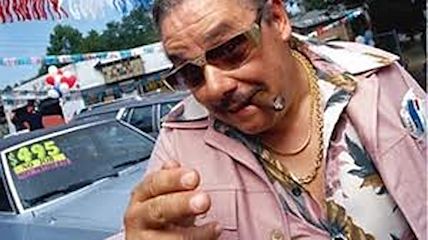
Sometimes, we blame our low self-esteem on others: the used car salesman in a plaid sports coat, the brush salesman in a polyester suit, the cosmetics sales lady in an old car.

Baloney.

Name a profession that hasn’t had it’s share of unprofessional perpetrators of perpetual sleaze.

Want to change the perception?  Start with the person you see in the mirror. Convince him or her that sales is an honorable profession and then act like it.

SleazySalesman

Change your attitude and change the world.

You can do it.  Do you see any reason we shouldn’t get started now?

The Usual Suspects

Usual Suspects article

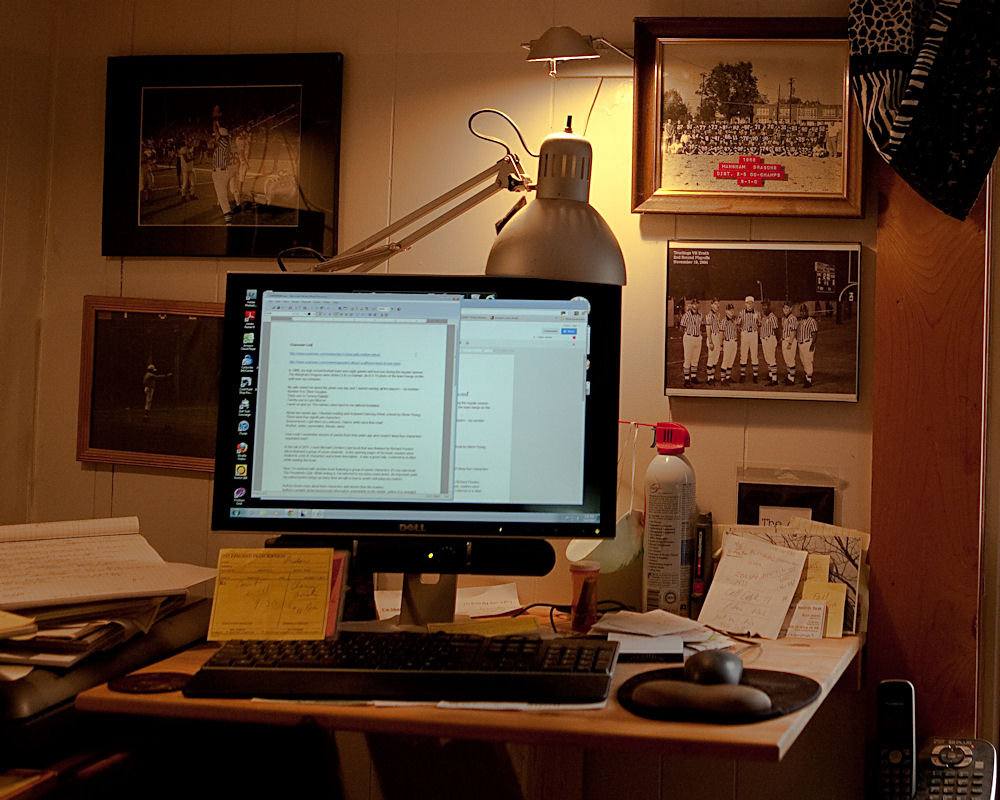
In 1968, my high school football team won eight games and lost one during the regular season. The Mangham Dragons were district 2-B co-champs. An 8 X 10 photo of the team hangs on the wall near my computer. (See top right, notice red label.)

My wife asked me about the photo one day and I started naming all the players — by number.
Number 8 is Oliver Douglas.
Thirty-one is Tommy Pailette.
Twenty-one is Lynn Mercer.
I went on and on. The names came back to me without hesitation.

About two weeks ago, I finished reading and reviewed Dancing Priest, a book by Glenn Young. There were four significant characters.
Several times, I got them so confused, I had to write out a flow chart.
Brother, sister, roommates, friends, twins.

How could I remember dozens of names from forty years ago and couldn’t keep four characters separated now?

In the fall of 2011, I read Michael Crichton’s last book that was finished by Richard Preston. Micro featured a group of seven students. In the opening pages of the book, readers were treated to a list of characters and a brief description. It was a great help. I referred to it often while reading the book.

Now, I’m involved with another book featuring a group of seven characters. It’s my own book, The Presidents Club. While writing it, I’ve referred to my notes many times. An important point my editor/mentor brings up every time we talk is how to avoid confusing my readers.

Authors know more about their characters and stories than the readers.
Authors certainly know background information unavailable to the reader, unless it is revealed in the written word.

If I cannot remember four characters and their relationships, why should my readers be expected to sort out and remember almost a dozen characters? An added complication is that my book is serialized, one chapter each week.

One step we will take soon is to begin presenting two chapters a week rather than one.

Another step is this list of characters with brief descriptions. When The Presidents Club becomes available as an e-book and a trade paperback, this same list will appear in the front near the opening pages.


Cast of main characters in The Presidents Club by FCEtier

John Hixon – ex-FBI agent hired by Thibaut to protect the Presidents Club

Julian Thibaut – billionaire investor/political activist currently promoting an initiative to improve government efficiency and encourage public participation

Gerald Point – chief of Thibaut’s personal security staff

Rosemary Woods – Thibaut’s secretary

Carl “Louie” Chaisson – former pharmacist now part owner/bartender of the Louisville Tavern


     The Presidents Club:

          Abraham “Abe” Region – retired school teacher now janitor at Holiday Inn Express

          Ronald Gold – U.S. Air Force retired, former member special ops

          Woodrow “Woody” Risk – retired Lowes manager, domino expert, and math savant

          George Ridge – general surgeon paralyzed from waist down, speed reader

          Thomas “Tommy” Pritchett – former Baptist minister

          Ulysses “Useful” Fishinghawk – retired college professor

          Franklin York – retired chiropractor, photographic memory

Care about the Future? Don’t Miss More than One Vote on PBS

Classic voting machine. Very similar to the one on which I cast my first vote in Louisiana.

Our guest blogger this week is Miriam Goldberg.

We are pleased to present her review of a documentary mentioned in Chapter Four of The Presidents Club.

===================

A deeply thought-provoking examination of the state of education in America and its impact on  politics, More than One Vote debuts this week on public television stations (see local listings for day and time). In an era when voters—and citizens eligible to vote who can’t be bothered—question the value of their votes and resent their exclusion from the processes of government “by the people,” More than One Vote examines Americans’ attitudes about self-governing and their familiarity with how government works.

According to More than One Vote,” A better educated and informed electorate will demand a more  responsible government.” The program explores the work and ideals of individuals and institutions developing programs to teach how government works; classes in Civics, American History, and Free Enterprise for school-aged students; activities including essay and poster contests; and programs that encourage voters to be better informed.

In addition to fostering education, an advocacy program is being designed, aimed to develop non-biased congressional watch groups, monitor congressional attendance and voting records, establish educational oversight groups, and  conduct government efficiency studies. Skeptics, such as this reviewer, may wonder if such an expansive project is too ambitious to succeed, but will secretly cross their fingers and hope this initiative will have a positive impact on American politics and society.

Participating in More than One Vote, are journalists, educators, activists, and representatives of organizations dedicated to improving education, social issues, government, and politics. Also interviewed are notables such as Henry Kissinger, Benita Bogart, Danny Glover, Lise Egstrom, and Rupert Murdoch.

————————————————————————–

More Than One Vote and this related review are works of fiction. Names, characters, corporations, institutions, and organizations mentioned are the product of the author’s imagination, or, if real, are used fictitiously without any intent to describe their actual conduct. Any resemblance to actual persons, living or dead, or events is entirely coincidental.

Disclosure — Take Bill’s word for it

What would happen if the President of the United States survived an assassination attempt (not by Claudia Barry) only to emerge from the hospital blind?
Sightless.
No hope of regaining his eyesight.
Would that mean he had lost his vision? [One of many clever double entendres from Safire.]

William Safire, the late New York Times columnist, addressed the issue of an impaired president in his book, Full Disclosure. Surprisingly, the twenty-fifth amendment addressed this issue in the constitution. Fortunately for Safire’s plot, but not for the nation, the authors of the addendum left the issue blurred — a bit out of focus.Full Disclsure - CVR

Since completing Safire’s book on presidential politics, I’ve begun reading one of several collections of his columns from the New York Times Sunday Magazine, “On Language.”

Take My Word for It was published in 1986 as a follow-up to its 1980 precursor, eponymously titled, On Language. Collections of essays are a favorite for me as it fits in with the demands of my reading time and offers a refreshing diversion.

Today’s reading includes this excerpt from Safire:
“My favorite calumniating adjective is revolving, a word with a spin on it. When asked why he called someone ‘a revolving S.O.B.,’ Harry Truman supposedly replied, ‘He’s an S.O.B. any way you look at him.’”

Word Origins and Their Romantic Stories is another preferred reference as well as an additional satisfaction for my hunger for a better understanding of words, their usage, and their etymology.

Watch for my articles on each of the above-named books.

Watch for them in the future, because as Criswell said so famously in Plan 9 from Outer Space, “We are all interested in the future for that is where you and I are going to spend the rest of our lives.”

Author Blog-in – Michael O’Gara

michael-ogara.com
Last updated 1-14-2013


Hello and welcome to my website!

Here you will find information on the novels I have written and you can even link to read free excerpts of the novels; sort of like taking a test drive. While you’re here please click on the contest page tab at the top of this page. I also invite you to visit my blog and other sites.

I hope you will look around and I’d love to hear from you. You may use the Contact the Author tab at the top of the page to leave a comment.

I hope you enjoy your visit.

P.S. Click HERE to visit my blog !

Proud to be an Awesome Indies Author !
Your Assurance of Quality
About Me

I live in Missouri with my wife Ronda who has provided the background photo work for some of my book covers. I am a full time author and I love the work. I see myself foremost as a story teller and my goal is to write books that entertain.

I’m a graduate of Fontbonne University where I earned Master of Fine Arts, Master of Arts and Master of Business Administration Degrees. I’ve lived all over North America in places as diverse as the Canadian sub-arctic and Florida. I’ve even been to the Arctic Circle. I’ve already lived a full and interesting life but it seems there may be much yet to come.

Free excerpt of the eBooks on this page in all major formats
are available at Smashwords.com by clicking any cover then scrolling down on the landing page to “Available eBook Reading Formats” and choosing your format sample.

Included above are the published e-Books in the Millie Mystery Series.

The Millie Mystery Series in chronological order: The Happenstance Marshal; The Deliberate Sheriff; The Persistent Sheriff; The Windfall Sheriff; The Mogul Sheriff; The Mentor Sheriff.

For information on any of the books please click on “About the Books”
on the menu ribbon on the top left of this page.

Home of the Millie Mystery Series. Enter contest for free books HERE.

Author Michael O’Gara

Author Blog-in Day, DVBerkom

DV Berkom’s latest release

Author Blog-In Day!
By dvberkom
Hey everybody!

Today is the first day of the Author Blog-In! I’m featuring my latest release, Bad Traffick, and will give away a print copy of the first book in the series, Serial Date, to one of the commenters on this blog! Stop back often, as each day I will post another participating author’s book. The blog-in runs through January 21st, so be sure to leave a comment on any of the blog-in articles posted here during that time to win!

BAD TRAFFICK, A Leine Basso Novel
Bad Traffick is the second book in the Leine Basso Series, and was picked as one of 5 BloodWrites Best Indie Picks for 2012 :
Identified as a person of interest in three cold case murders she didn’t commit and required to stay in L.A., ex-assassin Leine Basso accepts a temporary position as a security specialist for A-list actor Miles Fournier, who believes he is the target of kidnappers. Leine finds she has her hands full trying to protect the head-strong celebrity, while at the same time fighting her desire for Detective Santiago Jensen, a game she knows she can’t win.

Soon, a woman contacts Miles, claiming to be his long-lost sister. She confesses her twelve-year-old daughter, Mara, has been abducted by sex-traffickers and she’s desperate to get her back, hoping that Miles will use his considerable resources to find her.

Leine learns from a contact at a rescue organization that Mara escaped and is alone on the streets in the sprawling city of Los Angeles. The traffickers are determined to track her down and deliver her to the powerful client who purchased her for his twisted ends. Running out of time, Leine must find Mara before they do, or she will be lost forever.

BAD TRAFFICK can be purchased on Amazon.com. To find other Author Blog-In authors or to participate, go here.

Check out this great blog by my friend, Kate!

Kate Policani's avatarKate Policani

Compulsively Writing Fiction

Compulsively Writing  Fiction:

My experiences in Self-publishing in 2011

by Kate Policani

This is a FREE ebook

Smashwords: http://www.smashwords.com/books/view/102331

On Kobo

For Nook

I began my self-publishing journey in 2011, writing my first novel and working through the processes of publishing myself on CreateSpace and other publishers. This free ebook is the compilation of my experiences and discoveries from my blog. I have reorganized them and added some clarification to make a comprehensive view of and instruction for self publishing in this, the rise of the digital book movement.
This book is crafted to help all of you new self-publishers to live your dream and publish your book!

Another free ebook coming soon: Compulsively Writing More Fiction: My Continued Self-publishing Adventures in 2012

View original post